Stop blaming your lack of willpower for a biological battle your body is programmed to lose. The tabloid obsession with "miracle jabs" has turned a serious clinical breakthrough into a circus, leaving many people feeling more confused than ever. If you are looking into medical weight loss UK options, you've probably realised that the "eat less, move more" mantra is a gross oversimplification of how human metabolism actually functions. Obesity is a chronic medical condition, not a character flaw.
You're right to be sceptical of the hype and anxious about the rise of unregulated online sellers. This guide is a no-nonsense look at what medical weight loss in Britain actually involves, stripping away the marketing fluff to reveal the clinical science. We promise to give you the facts about how these treatments work on a cellular level and explain the strict legal requirements for a safe, regulated prescription in 2026.
We will explore the biological mechanisms of GLP-1 medications like Mounjaro and Wegovy, clarify the updated NHS and private eligibility criteria, and help you identify a provider that prioritises your safety over a quick sale. It's time to move past the headlines and understand the reality of evidence-based weight management.
Key Takeaways
- Understand why medical weight loss UK is a clinical correction for a biological condition, not a lifestyle shortcut or a "miracle" fix.
- Learn how GLP-1 and GIP hormones actually work to silence "food noise" and regulate your body's natural satiety signals.
- Identify the legal requirements for safe, regulated prescriptions and why a thorough clinical review is non-negotiable for patient safety.
- Discover how to navigate the online consultation process with UK-qualified professionals to ensure your treatment is appropriate for your health history.
- Gain insights into avoiding the "rebound effect" by prioritising clinical guidance and structured maintenance over the medication alone.
Table of Contents
- Medical Weight Loss in the UK: It Is Not a "Miracle Jab"
- The Biology of Hunger: Why Willpower Is Not the Problem
- Safety and Regulation: Busting the "Dangerous Shortcut" Myth
- Navigating the Prescription Process Without Your GP
- Sustainable Results: Why Clinical Support Matters More Than the Medication
Medical Weight Loss in the UK: It Is Not a "Miracle Jab"
Let's get one thing straight. Medical weight loss isn't a "slimming club" with a weekly weigh-in and a sticker for your effort. It's a clinically-supervised pharmacological intervention. When we discuss medical weight loss UK, we're talking about evidence-based treatments that target the biological drivers of obesity. It's about chemistry, not just character.
The media loves the term "miracle jab". It's catchy. It sells papers. But it's fundamentally misleading. These medications are tools. They are not magic wands that allow you to ignore your basic health. In the UK, this field is strictly overseen by the Medicines and Healthcare products Regulatory Agency (MHRA) and the General Pharmaceutical Council (GPhC). This oversight ensures that what you're receiving is safe, genuine, and clinically appropriate. There are no shortcuts here, only science.
The Distinction Between Lifestyle Changes and Clinical Intervention
Eat less. Move more. It sounds simple. For many, it isn't. Diet and exercise are the non-negotiable foundation of health, but biology often sets a ceiling that willpower cannot break. This is where anti-obesity medications come into play. They don't replace healthy habits; they make those habits physically possible by correcting hormonal imbalances that drive overeating.
Modern UK medicine now utilises sophisticated treatments like Tirzepatide and Semaglutide. These aren't lifestyle supplements. They are powerful GLP-1 receptor agonists that change how your brain and gut communicate. You can read more about the Weight Loss Jab UK to understand the blunt reality of how these injections function within a clinical setting. They provide the biological assistance required to break through weight plateaus that diet alone cannot touch.
Who Is Medical Weight Loss Actually For?
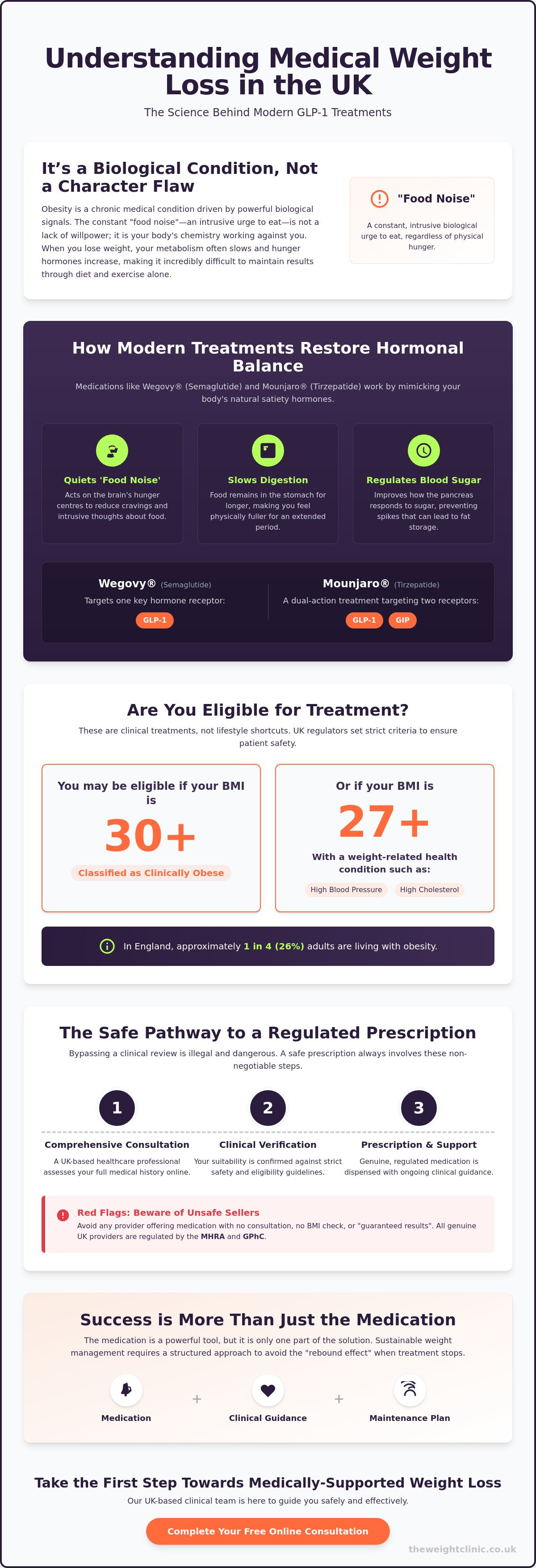
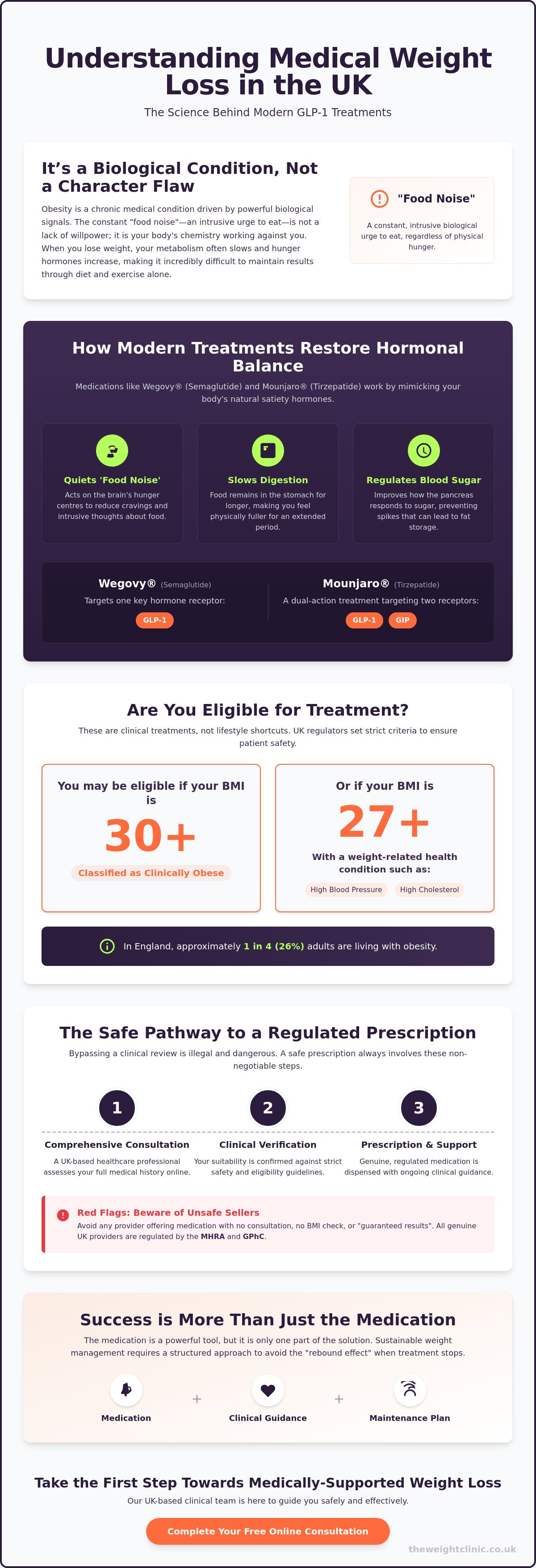
These treatments aren't for people looking to drop half a stone before a beach holiday. That's a vanity goal, not a medical one. Regulated UK clinics follow strict safety protocols. Eligibility is generally reserved for those with a BMI of 30 or above. If you have weight-related health issues like hypertension, high cholesterol, or pre-diabetes, the threshold may be 27 or above. Approximately 26% of adults in England are classified as obese, and for many of them, these medications are a vital medical necessity.
Quick fixes don't exist in regulated practice. If a website offers you medication without a consultation or a BMI check, they're breaking the law. Safe weight management requires a professional review of your medical history and ongoing support. It's a commitment to long-term health, not a shortcut to a smaller dress size. We focus on results that last, not just the number on the scale next Tuesday.
The Biology of Hunger: Why Willpower Is Not the Problem
Stop thinking of obesity as a choice. For years, the narrative has been that if you just tried harder, you'd succeed. This is medically illiterate. For many people pursuing medical weight loss UK, the real obstacle is "food noise". This is the constant, intrusive psychological urge to eat that dominates your thoughts. It isn't a lack of discipline; it's a biological signal that your brain is shouting at you, regardless of how much you've actually eaten.
Your brain is often working against your weight loss goals. When you lose weight through calorie restriction alone, your body's survival mechanisms kick in. It lowers your metabolic rate and ramps up hunger hormones to force you back to your previous weight. This isn't "weakness". It's a chronic metabolic disease. Modern medication doesn't bypass your effort; it corrects the internal chemistry that makes that effort feel impossible.
How GLP-1 Agonists Rewire Your Appetite
GLP-1 and GIP are naturally occurring hormones that tell your brain you're full. Medications like Mounjaro and Wegovy mimic these signals. One primary mechanism is delayed gastric emptying. This means food stays in your stomach for longer, physically extending the sensation of satiety. It also improves how your pancreas manages blood sugar, preventing the insulin spikes that lead to fat storage.
Tirzepatide is a dual-action agonist that targets both GLP-1 and GIP receptors to regulate metabolic signals. By hitting both pathways, it provides a more comprehensive suppression of food noise than single-hormone treatments. The UK Parliament evidence on weight loss drugs confirms that these interventions are essential tools for managing the systemic health risks associated with obesity. If you're ready to see if these clinical tools are right for your biology, you can start an online consultation today.
The Myth of the "Lazy" Solution
We don't tell people with high blood pressure to "just relax more" while refusing them medication. We don't expect people with high cholesterol to rely solely on "grit". Managing a chronic condition with evidence-based medication is standard medical practice. Using clinical support for weight management is no different. It's a pragmatic response to a physical health issue.
However, medication is not a free pass. Whilst on treatment, you must prioritise protein intake and resistance training. Rapid weight loss can lead to muscle wastage if you aren't careful. You want to lose adipose tissue, not the muscle that keeps your metabolism functioning. This is why professional guidance is vital; it's about losing weight safely and sustainably, not just quickly.
Safety and Regulation: Busting the "Dangerous Shortcut" Myth
The "dangerous shortcut" narrative is a favourite of tabloid headlines. It's designed to scare, not inform. In reality, medical weight loss UK is a highly regulated clinical pathway. It is not a gamble. It's a structured medical protocol overseen by the MHRA and GPhC. When handled correctly, these treatments are safe, effective tools for managing a chronic health condition. The danger doesn't lie in the medication itself, but in how and where you acquire it.
Safe treatment requires a legal prescription. In the UK, an online consultation isn't just a "formality" for our convenience. It's a legal requirement designed to protect you. A qualified clinician must review your BMI, medical history, and current medications to ensure suitability. If a provider offers these drugs without a consultation, they are operating illegally and putting your health at risk. The UK government guidance on weight loss medicines is clear: only use regulated, prescription-only channels.
Common Side Effects vs. Rare Clinical Risks
Let's be blunt about side effects. You will likely experience some. Nausea, fatigue, and digestive changes are common, especially in the first four weeks. This isn't "danger"; it's your body adjusting to a new hormonal signal. This is why we use an induction phase. You start at the lowest dose to let your system adapt. Most symptoms are mild and temporary.
Serious risks are rare but must be monitored. If you experience severe abdominal pain or persistent vomiting, you must seek medical advice immediately. This is why having a direct line to your clinical team is essential. When using treatments like Mounjaro, professional oversight ensures that any issues are caught early and managed properly. We don't just post you a pen and hope for the best; we provide a clinical safety net.
The Role of the UK-Registered Pharmacy
Integrity matters. A "weight loss pen" bought from an unregulated seller on social media is a massive risk. You have no guarantee of what's inside that pen or if it has been stored correctly. These medications are temperature-sensitive. They require cold-chain delivery to remain effective. If the medication gets too warm, the protein structure breaks down and the drug becomes useless or, worse, harmful.
Always verify your provider. Look for the GPhC registration. A legitimate UK-registered pharmacy will always require a prescription and will always use temperature-controlled logistics. The Weight Clinic is a pharmacy-led service. We prioritise clinical safety over marketing trends. If a site claims "no prescription required", walk away. That isn't a shortcut. It's a red flag that suggests the product is counterfeit or unregulated.
Navigating the Prescription Process Without Your GP
NHS wait times for specialist weight management clinics are currently estimated to be between 6 and 12 months. For many, that delay is unacceptable when health risks are mounting. Private medical weight loss UK services offer an alternative route, but speed should never be confused with a lack of rigour. This isn't about skipping the rules. It's about applying them with more efficiency through a dedicated pharmacy-led service.
The regulated path to treatment follows five non-negotiable steps to ensure patient safety:
- Comprehensive Assessment: You provide your BMI, health history, and details of any current medications.
- Clinical Review: A UK-qualified prescriber, such as a Pharmacist or Doctor, manually reviews your data.
- Verification: We verify your identity and check your eligibility against strict clinical criteria.
- Dispensing: A prescription is issued and fulfilled by our own UK-registered pharmacy.
- Cold-Chain Delivery: Your treatment is sent via discreet, tracked, and temperature-controlled delivery to maintain its integrity.
What Information Do You Actually Need to Provide?
Honesty is the only way this works safely. We need a full picture of your health, including any history of thyroid issues or pancreatitis. We also need a complete list of your current medications to check for potential interactions. If we ask for a photo or ID verification, it's to ensure the person receiving the medication is the person we've assessed. You can find more detail on this in our guide to Weight Loss Treatment Without GP.
The Online Consultation: Safety Over Speed
Some high-street providers make the process sound like a simple transaction. It isn't. A clinical consultation is a serious medical event. We don't "rubber stamp" every application that comes through our system. If your BMI is under the legal threshold, or if you have contraindications that make GLP-1s unsafe, we will decline your application. We prioritise your long-term health over a quick sale. This isn't just about getting a pen; it's about starting a supervised medical programme with professional accountability.
If you meet the clinical criteria and want to proceed with a regulated provider, you can start your online consultation now. We focus on providing a streamlined experience that never cuts corners on your safety.
Sustainable Results: Why Clinical Support Matters More Than the Medication
Medication is the engine, but clinical guidance is the steering wheel. If you treat medical weight loss UK as a short-term sprint, you're setting yourself up for the "rebound effect". This isn't a failure of the drug; it's a failure of the strategy. When you stop taking a GLP-1 medication without a structured plan, your body's survival instincts—those same hunger signals we discussed earlier—will return with a vengeance. Biology doesn't care about your goals; it cares about returning to its previous set point.
The myth that you must stay on these medications forever is just that: a myth. However, the counter-myth that you can use them for three months and walk away unchanged is equally dangerous. Integrating Wegovy or Mounjaro into a long-term health strategy requires more than just a weekly injection. It requires a fundamental shift in how you manage your metabolic health. At The Weight Clinic, our approach is built on straight-talk advice that prioritises your actual outcomes over easy marketing promises. We focus on physical reality, not aspirational fluff.
The Maintenance Phase: What Happens When You Stop?
The clinical reality is that obesity is a chronic, relapsing condition. Research confirms that without "wraparound care"—which includes nutritional and behavioural support—many patients regain weight once the biological suppression of hunger is removed. You must use the time on medication to build "behavioural scaffolding". This means establishing sustainable habits whilst the medication is doing the heavy lifting of silencing the food noise. It's about training your brain whilst the drug manages your gut.
Stopping "cold turkey" is rarely the best path for long-term success. A slow titration down, managed by a qualified clinician, allows your metabolism to adjust to the change in hormonal signalling. This methodical reduction helps you maintain your progress without the sudden, overwhelming shock of a returning appetite. Success is measured by where you are two years after your first dose, not just two months in. We aim for permanent change, not a temporary dip on the scale.
Choosing a Clinic Based on Integrity, Not Just Price
It's tempting to hunt for the lowest price. But the "cheapest" providers often operate on a high-volume, low-support model. They post the pen and disappear. A pharmacy-led service provides value because we understand the underlying biology of the medication. We know that safety and efficacy depend on professional accountability and being available when the process gets difficult. You are paying for clinical expertise, not just a plastic pen.
Don't settle for a transactional relationship with your healthcare. Look for a provider that prioritises clinical review and evidence-based care over a quick sale. If you're ready for a no-nonsense approach to weight management, start your online consultation for a clinical review today. It's time to stop chasing miracles and start following the science.
Take the First Step Toward Biological Balance
Moving past the "miracle jab" headlines is the only way to achieve lasting change. Medical weight loss UK is about using science to silence the biological noise that has held you back for years. It is a structured, clinical process that treats obesity as the chronic metabolic condition it truly is. By choosing a regulated path, you ensure that your progress is safe, monitored, and sustainable.
The Weight Clinic provides access to clinically-proven treatments like Mounjaro and Wegovy through our UK-registered pharmacy (GPhC). We don't just ship medication; we ensure it arrives via discreet, temperature-controlled delivery to protect its clinical integrity. You deserve a provider that prioritises your safety and offers straight-talking, professional guidance throughout your treatment.
Stop fighting a battle against your own hormones. Start your free online medical consultation for weight loss today to see if our clinical approach is the right fit for your health goals. We are ready to help you build a healthier future based on evidence, not hype.
Frequently Asked Questions
Is medical weight loss available on the NHS for everyone?
No, NHS access is strictly limited by NICE eligibility criteria. As of 2026, the NHS prioritises patients with a BMI of 40 or above with three comorbidities, or a BMI of 35 or above with at least four weight-related conditions. Even if you meet these expanded requirements, waiting times for specialist clinics often range from 6 to 12 months. Many patients choose private medical weight loss UK services to avoid these delays.
Can I buy Mounjaro or Wegovy online legally in the UK?
You can buy these treatments legally only through UK-registered pharmacies that require a clinical consultation. It's illegal and dangerous to purchase "pens" from social media or unregulated websites without a prescription. A legitimate provider will always verify your identity and medical history. This process ensures the medication is appropriate for your biology and that you receive genuine, temperature-controlled products dispensed by qualified professionals.
What happens if I don’t lose weight on the starting dose?
Don't be discouraged if the scale doesn't move immediately. The initial 2.5mg dose of Mounjaro or 0.25mg of Wegovy is an "induction dose" designed to sensitise your body to the medication and minimise side effects. It isn't intended for maximum weight loss. Most patients see significant results only after they titrate up to the higher maintenance doses. Your clinician will manage this schedule based on your individual response and tolerance.
Do I have to tell my GP if I start private weight loss treatment?
You aren't legally required to inform your GP, but it's strongly advised for your own safety. Regulated clinics will ask for your consent to share your treatment plan with your doctor. This ensures your primary care team has a complete picture of your health. It also prevents potential drug interactions if your GP prescribes new medications in the future. Transparency between providers is a cornerstone of safe clinical practice.
Are weight loss injections safe to use long-term?
Clinical trials show that GLP-1 medications are safe for long-term use when supervised by healthcare professionals. Because obesity is a chronic, relapsing condition, many patients require ongoing biological support to maintain their weight loss. However, long-term use must be monitored. Regular clinical reviews help track your progress and check for rare complications. Your prescriber will help you decide whether to continue treatment or begin a structured maintenance phase.
What are the most common side effects of GLP-1 medications?
Gastrointestinal issues are the most frequent side effects reported by patients. You should expect mild to moderate nausea, diarrhoea, or constipation, particularly during the first few weeks of a new dose. These symptoms usually subside as your system adapts to the hormonal changes. Staying hydrated and prioritising protein can help manage these effects. If side effects become severe or persistent, you must contact your clinical team for professional guidance.
How much does medical weight loss typically cost in the UK?
The cost of medical weight loss UK varies depending on the specific medication prescribed and the level of clinical support included. Generally, private fees cover the online consultation, the private prescription, the medication itself, and cold-chain delivery. Whilst some providers offer low-cost options, these often lack the essential pharmacy-led oversight required for safe titration. It's better to prioritise a service that includes ongoing access to qualified clinicians and regulated dispensing.
Can I switch from Wegovy to Mounjaro if one doesn’t work?
Switching between medications is possible but requires a fresh clinical assessment. You cannot simply swap one pen for another at the same dose level because the active ingredients and biological mechanisms differ. A clinician must determine the appropriate "washout" period and the correct starting dose for the new treatment. This cautious approach prevents severe side effects and ensures your body responds effectively to the new pharmacological signal.
Disclaimer
The information in this article is for general educational purposes only and should not be taken as personal medical advice. Weight-loss treatments, including prescription medicines, may not be suitable for everyone and require a clinical assessment by an appropriately qualified healthcare professional. Do not start, stop or change any medication without speaking to a prescriber or healthcare professional. If you have urgent symptoms or feel unwell, seek medical advice promptly or contact NHS 111 / emergency services where appropriate.